
How many house construction checklists are there here?
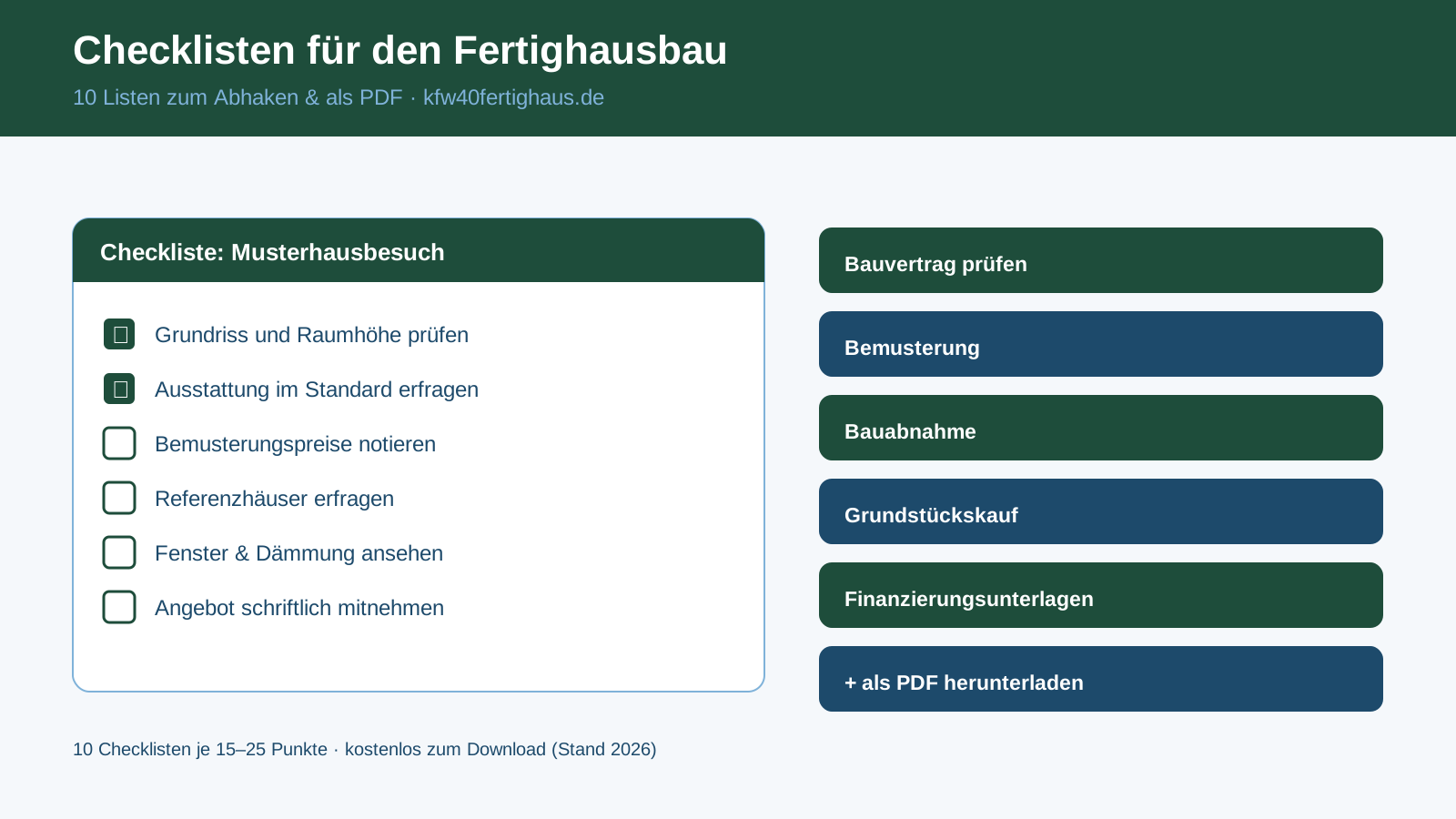
Short answer: This collection includes 11 checklists with a total of 185 inspection points – from the first orientation in the show home to moving in. Each list is free of charge, you can tick it off on the screen or download and print it as a PDF. This allows you to keep track in every construction phase, regardless of which provider you choose.
House construction consists of many individual steps that span months and rarely run in a straight line. Between the first show home visit and the key handover there are quote comparisons, building plot purchase, financing, construction contract, finishes selection, the actual construction phase, subsidy applications, the building acceptance and finally the move. In each of these phases there are details that can easily be overlooked and cost money or cause stress later. The checklists are intended for exactly this purpose: they summarize the key questions so that you do not forget anything important.
The lists are deliberately formulated to be provider-neutral and practical. You do not need specialist knowledge to use them – each point is worded so that you can address it directly in conversations with advisors, banks or construction managers. Those who proceed in a structured way will deal with providers more confidently and recognize more quickly where an offer is weak or incomplete.
Which checklists do I need in which construction phase?
The following overview assigns each checklist to a construction phase and shows for whom it is particularly important. This allows you to see at a glance which list is next. You do not necessarily have to work through the lists in order – each one can stand alone. In practice, however, it helps to roughly follow the construction sequence so that, for example, you have clarified the financing before signing a construction contract.
All checklists at a glance by construction phase and target group (Stand 2026).
| Checklist | Construction Phase | For Whom |
|---|---|---|
| Documents for the House Sale | Construction Phase | Builder-Owners |
| Show Home Visit | Orientation | Prospects before Provider Selection |
| Check Construction Contract | Contract | Builder-Owners before Signing |
| Finishes Selection | Equipment | Builder-Owners during Finishes Selection |
| Building Acceptance | Acceptance | Builder-Owners at Handover |
| Building Plot Purchase | Building Plot | Buyers before the Notary Appointment |
| Financing Documents | Financing | Builder-Owners before the Bank Meeting |
| Moving In | Moving In | Builder-Owners around the Move |
| Construction Site Visit | Construction Phase | Builder-Owners during Construction Time |
| Subsidy Applications | Subsidy | Builder-Owners before Construction Start |
| Provider Comparison | Orientation | Prospects in the Quote Comparison |
If you are just starting out, begin with the show home visit and the provider comparison. As soon as a building plot and the rough financing are secured, the construction contract and finishes selection move into focus. During the construction period the construction site visit and the subsidy applications accompany you, before building acceptance and moving in complete the process. Those who prefer to learn about their project step by step will find in the House Construction Course a guided introduction to exactly these phases.
Documents for the House Sale(16 Points)
These documents are requested by buyers, banks and notaries for the sale – the more complete the folder, the smoother the process.
- Current land register excerpt (not older than 3 months)
- Site map / property map from the cadastral office
- Energy certificate (legal obligation already at the viewing)
- Floor plans, sections and views of the building
- Living area calculation and volume calculation
- Construction description and building permit
- Proofs of modernizations and renovations (invoices)
- Ground charges: inquire redemption values at the bank
- For rental: tenancy agreements and utility bills
- For condominium: declaration of partition and minutes of owners' meetings
- For condominium: business plan and house fee statements
- Insurance certificates (residential building insurance)
- Development and adjacent owner contribution notices
- Proof of building lease or rights of way, if applicable
- List of included fixtures sold (kitchen, awnings, PV system)
- Prepare all documents as PDF folder for interested parties
Show Home Visit(16 Points)
So that you check the right things in the show home and distinguish the standard from the upgrade options.
- Check opening times and arrange an appointment with advisor
- Have the floor plan, room height and ceiling height specifically measured
- Which equipment belongs to the standard price, what is an extra charge?
- View windows, doors and floors for material and workmanship
- Have insulation and wall construction explained by the advisor
- Inspect the heating technology and ventilation system in the house
- Inquire about sockets, switches and lighting design in the standard
- Inquire about selection prices for floors, bathrooms and kitchen
- Request reference houses in the region and contact details of builder-owners
- Discuss construction time, reliability and the provider's process
- Clarify the energy standard (GEG, KfW 40) of the house
- Take photos and note equipment details immediately
- Take a written offer with description of services with you
- Compare several show homes from different providers
- Do not provide any signature or down payment on site
- Note and ask questions regarding warranty and service
Check Construction Contract(17 Points)
Before you sign: These points decide on cost certainty and your rights.
- Complete construction and services description as integral part of the contract
- Fixed price and validity period of the price clearly regulated
- Binding completion date agreed with calendar date
- Payment schedule linked to construction progress, no high prepayments
- Statutory upper limits for progress payments complied with
- Regulations on variations and additional costs transparent
- Completion security (5 %) and contractual penalty for delay
- Right of withdrawal and instruction included (consumer construction contract)
- Services such as earthworks and connections clearly assigned
- Builder-owner services ('bauseits') fully listed
- Warranty period of usually five years specified
- Regulations regarding construction acceptance and handover protocol
- Insurance obligations during the construction phase clarified
- Termination and rescission conditions understandable
- Have the contract legally reviewed before signing
- Include all verbal commitments in the contract in writing
- Check annexes and plans for completeness
Finishes selection(17 points)
So that the choice of fittings does not become a cost trap - prepared for the finishes selection.
- Set the finishes selection budget in advance and record it in writing
- Create a priorities list: Where high-quality, where standard?
- Know the standard specification of the contract exactly
- Select floor coverings for each room and compare prices
- Specify tiles, sanitary objects and fittings in the bathroom
- Select interior doors, frames and hardware
- Electrical planning: sockets, switches, network, exterior sockets
- Plan the lighting concept and number of connections per room
- Finalize heating and ventilation technology
- Define kitchen connections and position of the connection points
- Choose window sizes, opening types and shading
- Select stairs, railings and materials
- Plan smart home pre-wiring and empty conduits
- Have each upgrade position confirmed in writing
- Check the total of the upgrades after the finishes selection
- Do not decide anything under time pressure, take time to consider
- Review the finishes selection protocol and retain it
Construction acceptance(17 points)
The acceptance is legally decisive - inspect thoroughly before signing.
- Carry out acceptance only when the house is essentially completed
- Engage an independent expert for the acceptance
- Take the construction and services description as inspection basis
- Check all rooms for completeness and execution
- Inspect walls, ceilings and floors for cracks and evenness
- Test windows and doors for function and tightness
- Test the electrical installation, sockets and switches
- Commission heating, ventilation and hot water and inspect them
- Check sanitary objects for tightness and function
- Inspect roof, facade and connections from outside
- Record all identified defects in writing
- Prepare photos of the defects with date as evidence
- Record the deadline for defect rectification in the protocol
- Appropriately withhold remaining payment for defects not remedied
- Document meter readings for electricity, water and gas
- Take over operating instructions and documentation
- Sign the acceptance protocol only after complete inspection
Building plot purchase(17 points)
Before the purchase: These points determine whether the desired house can be built at all.
- Clarify buildability and type of use of the building plot
- Read development plan: height, number of stories, roof shape, building boundaries
- Check land register extract: ownership, rights, encumbrances
- Inspect building charges register for obligations
- Check development level: road, water, sewage, electricity
- Calculate development costs if not developed
- Obtain soil report regarding load-bearing capacity and groundwater
- Research contaminated sites register and previous use
- Evaluate plot shape and orientation
- Check location, infrastructure and neighboring development
- Assess noise sources, traffic and immissions
- Compare land reference value with purchase price
- Factor in property transfer tax and notary costs
- Clarify access, rights of way and utility rights
- Check risks of flooding and slope water
- Have the purchase contract legally reviewed before signing
- Secure financing approval before the notary appointment
Financing documents(17 points)
Everything the bank needs for a quick and good financing offer.
- Current salary statements from the last three months
- Income tax assessments from the last two years
- Proof of available equity capital and reserves
- Current account statements and assets overview
- Proof of existing credits and liabilities
- Complete self-disclosure and household budget
- Purchase contract or reservation of the building plot
- Construction contract and construction and services description
- Land register extract of the building plot
- Site plan, floor plans and construction plans
- Living area and construction costs calculation
- Photos of the building plot or the property
- Proof of own contributions with realistic valuation
- Prepare documents for subsidies (KfW, state)
- Identity card and registration confirmation
- Proof of existing insurances
- Information on planned additional costs and reserves
Moving in(17 points)
So that the start in the new home succeeds smoothly - before, during and after the move.
- Set the moving date early and organize moving helpers
- Plan the registration with the residents registration office
- Register contracts for electricity, gas and water
- Commission internet and telephone connection in good time
- Set up mail forwarding order with the post
- Change of address with bank, employer and insurance companies
- Take out building insurance and household contents insurance
- Read meter readings on move-in and document them
- Test all functions in the house before moving in
- Document key handover and number of keys
- Check smoke detectors for functionality
- Define cleaning plan before assembling the furniture
- Coordinate delivery dates for furniture and kitchen
- Consider re-registration for children, school and nursery
- Re-register radio license fee
- Register waste bins and waste disposal
- Make contact with new neighbors
Construction site visit(17 points)
Accompany the construction meaningfully without disturbing the sequence - point by point.
- Coordinate visit appointments with the construction management
- Wear safety shoes, helmet and warning vest
- Document construction progress with photos and date
- Compare dimensions and positions with the plans
- Check and photograph location of lines and connections
- Inspect floor slab for dimensional accuracy and moisture barrier
- Check walls and ceilings for visible abnormalities
- Inspect insulation and vapor barrier before closing
- Check window and door installation for tightness
- Observe cleanliness and order on the construction site
- Compare materials with the construction description
- Note open points but do not intervene yourself
- Clarify questions exclusively via the construction management
- Agree on changes only in writing
- Keep a construction diary with date, weather and progress
- Report anomalies to the provider immediately in writing
- Keep children and unauthorized persons away from the construction site
Subsidy applications(17 points)
So that deadlines are not missed and subsidies and favorable loans are optimally utilized.
- Research funding options from federal, state and municipality
- Involve energy efficiency experts early on
- Define the subsidy-eligible energy standard (e. g. KfW 40)
- Check application deadlines: submit application before construction starts
- Prepare KfW application via the financing bank
- Check BAFA grants for heating technology
- Research state funding and family funding
- Check combination options of the programs
- Compile required proofs and confirmations
- Request contractor declarations in a timely manner
- Attach cost estimates and offers to the applications
- Coordinate the schedule of applications with the construction schedule
- Wait for approval notices before beginning the measures
- Prepare proof of use for the disbursement
- Permanently archive all notices and receipts
- Report changes to the project to the funding agency
- Document disbursement and repayment conditions
Provider comparison(17 points)
Compare prefabricated house providers fairly - according to services, not only according to the starting price.
- Select at least three providers for the comparison
- Communicate identical requirements to all providers
- Compare the construction and services descriptions in detail
- Contrast the included scope of performance
- Normalize price for equivalent specification, not only starting price
- Check energy standard (GEG, KfW 40) per provider
- Compare construction method, wall structure and insulation values
- Inquire about construction time and deadline reliability
- Compare warranty and scope of services
- Obtain reference houses and experiences of other builder-owners
- Check quality seals like QDF
- Compare fixed price guarantee and its validity period
- Evaluate payment plan and advance payments
- Inquire about handling of supplements and additional costs
- Clarify individual planning and change requests
- Check financial stability and history of the provider
- Evaluate overall impression from consultation, offer and transparency
How do I work with a house construction checklist?
A checklist unfolds its benefit only if you use it actively and not just read it once. It is most effective to print the appropriate list before each important appointment or keep it open on the screen and go through the points one by one. Check off what you have clarified. Note open points as questions for the next conversation with advisor, bank or construction management. This turns a collection of keywords into a concrete discussion guide.
Use the lists also as a memory aid over a longer period. Between the first show home visit and the signature on the construction contract, weeks or months often pass. Much of what appeared clear in the first conversation fades again. If you record your notes directly at the appropriate points, you always have the current status before your eyes and do not have to rely on your memory. It is best to assign photos, offers and written commitments thematically so that you can access them quickly later.
A second important point is prioritization. Not every point weighs equally. For example, in the fit-out your budget decides where you fit out to a high standard and where standard is sufficient. In the case of the construction acceptance, legally sensitive points such as the handover protocol and the defect notification are significantly more important than cosmetic details. Therefore, mark the points that are particularly relevant for your project and give them priority in the conversation.
If you want to take on parts of the house yourself, it is worth taking an early look at the financial effect. How much you can realistically save depends on your skills, your time and the chosen fit-out stage. An initial classification is provided by the calculator for Own contribution during house construction. Record planned own contributions additionally in the financing documents, as banks only evaluate the so-called muscle mortgage if it is realistically specified.
Finally, you should consistently document changes in writing. Oral commitments on the construction site or in the consultation are difficult to prove in the event of a dispute. The checklists indicate at several points to confirm agreements in writing. If you adhere to this, you will then have robust documents in case of doubt and not just your memory.
What belongs on every checklist?
As different as the individual construction phases are, some basic rules run through almost every good house construction checklist. The first place is always the question of the completeness of the performance. Whether in the show home, in the construction contract or at acceptance: You should always know which performance is included in the price and which is to be borne separately as an extra charge or as so-called client-provided service. It is precisely at this boundary that most unexpected additional costs arise.
The second constant issue is the building description. It is the most important document of the entire project because it specifies what is actually built. A good checklist reminds you to check the building description line by line rather than relying on advertising texts or show homes. The guide to explains how to proceed and which formulations you should watch out for. Building description during house construction. Vague formulations, placeholders or missing items are warning signals that you should clarify before signing.
Thirdly, it is about cost and deadline security. A binding fixed price with a clear validity period, a payment plan linked to the construction progress and a binding completion date belong on every serious contract checklist. We deliberately do not mention fixed prices on this page because they vary greatly depending on region, size and equipment. As a rough guide, turnkey houses Stand 2026 are in a range of around 2.500 to 3.800 euros per square meter, but only individual offers for your specific project provide reliable figures.
Fourthly, documentation is part of every checklist. Photos with date, written protocols, recorded meter readings and archived notices secure your position. Especially during construction site visits, construction acceptance and move-in, gapless documentation is invaluable if it later comes to warranty or defects.
Fifthly and finally, it is worthwhile to obtain a second opinion at decisive points. Whether an independent expert at the acceptance, a legal review of the construction contract or an external view on a submitted offer: The effort is small in relation to the construction sum and can prevent expensive mistakes. You can find an overview of further tools and information offers for builder-owners in the Area for builder-owners.
Frequently asked questions on the house construction checklists
Are the house construction checklists really free of charge?
Yes, all 11 checklists on this page are free of charge. You can go through each list on the screen and check it off or download it as a PDF and print it. No registration is required for this.
How many checklists are there and what topics do they cover?
There are 11 checklists with a total of 185 check points. They cover the most important phases: show home visit, provider comparison, building plot purchase, construction financing documents, construction contract, fit-out, construction site visit, subsidy applications, construction acceptance and move-in.
In which order should I use the checklists?
It makes sense to follow the order of the construction process: first orientation at the show home and provider comparison, then building plot and financing, then construction contract and fit-out, then construction site visit and subsidy applications and finally construction acceptance and move-in. However, each list also stands alone and can be worked through individually.
Do the checklists replace independent advice?
No. The checklists help you to systematically ask the right questions and not forget anything. For legally or financially important steps such as the construction contract or the construction acceptance, an independent review by an expert or a professional can additionally be useful.
Can I use the checklists for any provider?
Yes. The points are deliberately formulated in a provider-neutral way and can be applied to any prefabricated house or shell house for self-finishing project. Simply adapt individual positions like equipment or construction method to your specific offer.
What does a prefabricated house cost in addition to the points on the lists?
The checklists themselves do not contain fixed prices because costs depend strongly on region, size and equipment. As a rough guide, turnkey prefabricated houses Stand 2026 are mostly in a range of about 2.500 to 3.800 euros per square meter, plus building plot, ancillary construction costs and outdoor facilities. Only individual offers provide concrete figures.
Matching the checklists
You can find in-depth guides in the guide to checking the construction contract, in the fit-out checklist and in the building plot check. If you already have offers, the offer check helps to uncover gaps and unclear positions. The page shows how you can systematically obtain several offers and make them comparable. House construction offers.
From the checklist to the concrete offer
Checklists structure the way – for prices and fittings in your region you need concrete offers. Request suitable offers for free and compare them at your leisure.
