
Prefabricated house with basement 2026: Prices, tank types & additional costs
The detailed price comparison prefabricated house with and without basement for 2026: Additional price from 42.000–98.000 €, white in comparison to the black tank, price per square meter of additional usable area, KfW relevance and which manufacturers take over the basement fabrication themselves at a fixed price.
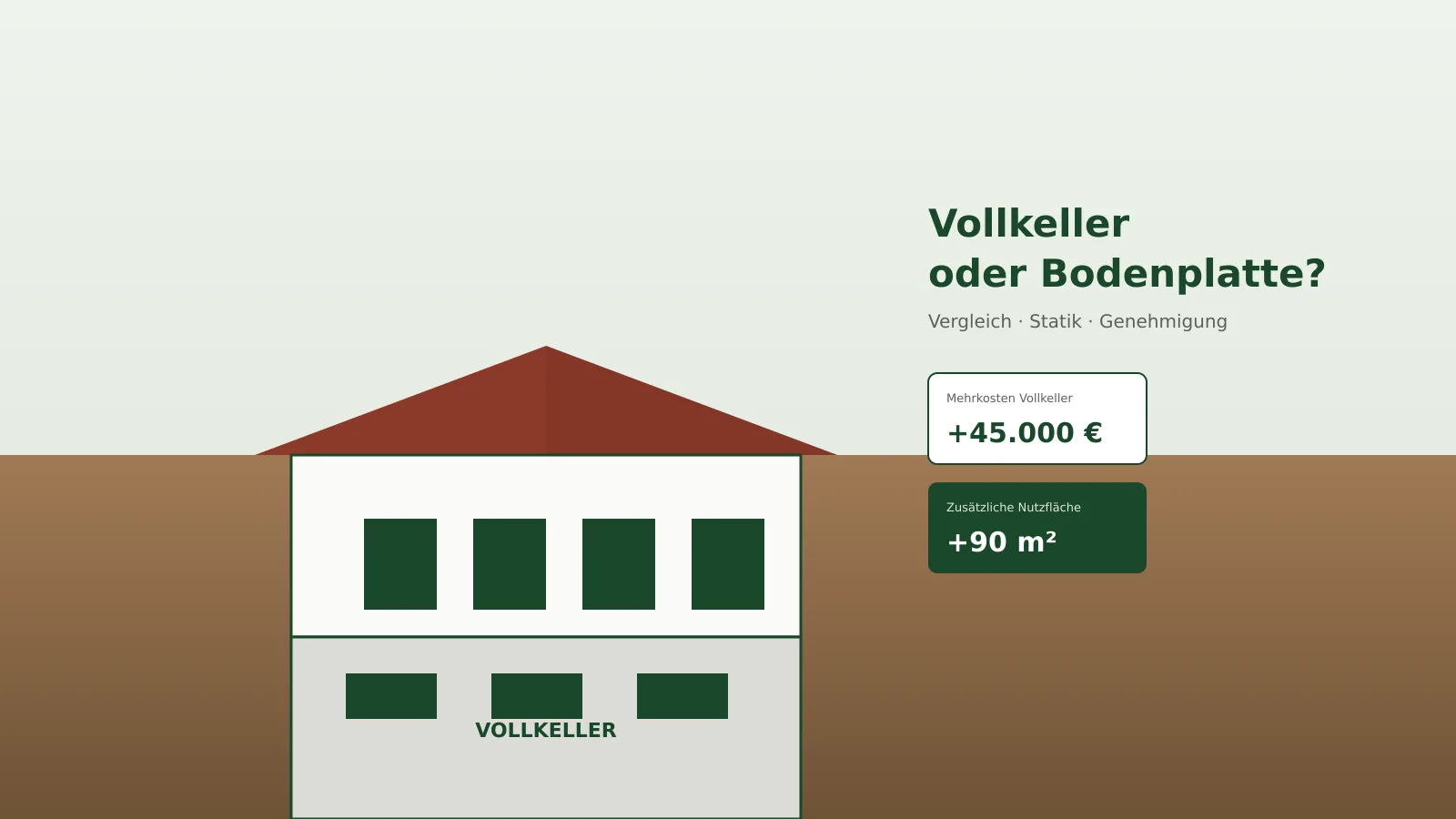
"What does a basement cost for the prefabricated house - and is the surcharge worth it?" This is the question builder-owners ask us most frequently. The honest price answer: Purely calculated a basement often does not pay for itself; statically, in planning and for later use it can nevertheless be worth the additional price. This guide quantifies the additional costs 2026 at 45.000 to 95.000 euros, compares the prices of white and black tank, clarifies the KfW crediting and names providers with their own prefabricated basement program. How the basement price fits into the overall budget is shown by the prefabricated house prices 2026; a basement-free alternative is the bungalow as prefabricated house.
Does the basement price pay off for the prefabricated house in 2026?
Short answer: In price terms, a basement in 2026 pays off especially when building land is expensive and scarce: From plot prices of 700 Euro/m² underground usable area is usually cheaper than an additional above-ground floor. In hillside locations excavation for the floor slab is required anyway, resulting in a lower price premium. On large inexpensive plots in the countryside the basement hardly ever pays off in price - a bungalow with attached garage is significantly cheaper there.
Compared to a pure floor slab, a basement in 2026 adds 45.000 to 95.000 euros - depending on base area, tank type (black or white tank), depth (half or full basement) and equipment (living basement with windows and heating or pure utility basement). This equates to 350 to 700 euros per square meter of basement usable area - considerably less than above-ground living area, which costs between 2.500 and 3.300 euros per square meter in 2026. It is precisely this price difference that determines the cost-effectiveness.
A price comparison on the building land illustrates this: On a 600-m² plot in the Munich area (land value 1.450 Euro/m²) every square meter of living area gained in the basement saves around 4.000 euros compared to a wider floor slab plus an additional floor. There, a full basement with 95 m² usable area as living cost equivalent usually pays for itself within 12 to 18 years. In the surrounding area of Leipzig or in Saxony-Anhalt with a land value of 60 Euro/m², however, the additional price never amortizes.
Black, white and brown tank: the prices of the sealing
Short answer: The three sealing systems differ fundamentally in technology and price: The black tank seals on the outside with bituminous membranes or plastic-modified thick coatings and is the most affordable. The white tank relies on water-impermeable concrete without additional external sealing - but it costs more. The rare brown tank works with swelling bentonite mats and is priced in between. Which system is suitable depends on the groundwater level, soil class according to DIN 18533 and the use: For utility basements the black tank is 25 to 40 percent cheaper, for living basements in pressing water the white tank pays off in the long term.
Tank types compared by price and performance (Stand 2026)
| Criterion | Black tank | White tank | Brown tank |
|---|---|---|---|
| Material | Bitumen membrane / KMB | WU concrete (B 35) | Bentonite mats |
| Sealing principle | External, glued/sprayed | Component itself waterproof | Swelling seal external |
| Application | after construction | monolithic in cast | before backfilling |
| Pressing water | conditionally suitable | suitable (with measures) | suitable |
| Service life | 30–50 years | 60–80 years | 40–60 years |
| Additional costs / 100 m² | +0 (basis) | +15.000–25.000 € | +8.000–14.000 € |
| Repair possible | difficult | very difficult | possible |
Which tank offers the best price-benefit ratio results from the soil report and usage plan. If the basement is to be used as living space later (hobby, office, granny annex), the living value justifies the additional price of the white tank with internal insulation - it keeps out moisture and ensures a habitable climate. Those who use the basement only as storage, utility and heating room are better served with the cheaper black tank. In locations with stratum water or high groundwater the white tank is still the smarter investment, because a subsequent remediation of the black tank quickly costs 30.000 to 80.000 euros.
Stratum water as a cost trap
Stratum water is water that accumulates on impermeable soil layers - independent of the groundwater and especially after heavy rain. It is often underestimated in the soil report, which can be expensive later. Explicitly request a statement on the stratum water risk; if it is missing, insist on an addition. Stratum water is one of the most common causes of basement water damage in the first ten years of use - and thus for high follow-up costs.
KfW subsidy and basement: can the additional price be financed favorably?
Short answer: For the basement itself there is no KfW grant in 2026. However, the basement wall counts as part of the thermal envelope and is included in the efficiency house standard - a well insulated basement wall is a prerequisite for the KfW-40 or KfW-Plus subsidy. With KFN 297/298 you can finance the basement together with the house price up to 150.000 euros per residential unit at a reduced interest rate - this reduces the effective costs of the additional price. However, there is no own "basement bonus".
Decisive for the efficiency house calculation and thus for the costs: If the basement is heated (residential use or utility room with radiator), its exterior wall belongs to the thermal envelope and must achieve U-values ≤ 0,30 W/(m²·K) - this drives the insulation price. In the case of an unheated utility basement the thermal boundary runs between the ground floor and basement (via the basement ceiling), the basement wall remains uninsulated - usually the more favorable variant in terms of price.
All details on the KfW subsidy 2026 and its programs are provided by the KfW Guide; how the additional cost fits into the overall financing is shown by the Construction Financing Guide 2026. With the Cost Calculator the additional basement costs can be clearly integrated into the budget.
Costs in detail: the basement price 2026 item by item
Short answer: A full basement (usable area like the ground floor area, room height ≥ 2.30 m for residential use) is priced at 48,000 to 95,000 euros in 2026 for 100 m² floor area. A half basement (room height 1.80–2.20 m, no full residential space) ranges between 30,000 and 55,000 euros. In addition there are earthworks, drainage and if applicable light wells or windows. The strongest price drivers are the soil class (rock significantly increases costs), the groundwater level and the tub type.
Full basement with 100 m²: prices 2026 position by position
| Position | Black tub | White tub |
|---|---|---|
| Excavation and disposal (BK 3) | 8.500 € | 8.500 € |
| Floor slab / blinding layer | 6.500 € | included in WU concrete |
| Basement walls incl. reinforcement | 16.500 € | 23.500 € |
| External sealing bitumen / KMB | 5.500 € | 0 € (not applicable) |
| Perimeter insulation XPS | 4.500 € | 5.500 € |
| Basement ceiling + impact sound insulation | 9.500 € | 9.500 € |
| Drainage + filter fleece | 3.500 € | 2.000 € |
| Light wells (4 pieces) | 1.800 € | 1.800 € |
| Windows + external doors basement | 4.500 € | 4.500 € |
| Heating/sanitary preparation | 2.000 € | 2.000 € |
| Total (additional costs compared to floor slab) | ~48,000 € | ~72,000 € |
This price matrix assumes an average slope location in soil class 3 (grown loose rock) without pressing groundwater. If rock (class 6/7) or difficult to excavate soil is present the excavation costs increase by 4,000 to 12,000 euros. For pressing groundwater security measures (sheet piling, water control) from 8,000 to 25,000 euros are added. Insist on a separate position for the earthworks with soil class reservation in the offer - otherwise additional excavation quantities appear on the invoice only at the end of construction and exceed the budget.
With which provider is the basement the most affordable?
Not every company from our selection of 40 manufacturers supplies the basement in-house. We arrange three providers with their own prefabricated basement production or proven basement building partners - at a transparent fixed price.
Which prefabricated house companies include the basement at the fixed price?
Short answer: Around 60 percent of the providers supply the basement from a single source in the general contractor contract together with the house - often at a convenient but not always the most affordable price. The rest require that the builder-owner commissions a basement builder themselves. Companies with their own prefabricated basement production (such as Glatthaar, Knecht, Knauf-Fertighaus, KAMPA or Hanse Haus) usually offer the best price-performance ratio as the basement elements are produced in parallel with the house prefabrication in the factory and save installation time.
The advantages of a complete price including the basement: one contractual partner, one fixed price guarantee, one site manager, one construction performance insurance and a five-year warranty according to BGB for the entire work. The disadvantage: the price calculation remains opaque and the basement is not infrequently somewhat too expensive because the provider passes it on with a markup from the subcontractor. Obtaining 1 to 3 comparative offers from regional basement builders often saves 8 to 15 percent - but then the interface to the prefabricated house construction must be coordinated by the client.
The interface between basement and house assembly
The basement ceiling must be exactly level and dimensionally accurate before the prefabricated house is placed on it - the tolerance is usually ± 5 mm over 10 m length. Have the measurement acceptance documented between basement builder and house provider preferably by an independent building expert. Without formal handover of the floor slab or basement ceiling each party later shifts the responsibility - and the costs - to the other.
Floor slab as alternative: usually more affordable than the basement
Short answer: In 6 out of 10 cases the floor slab in place of a basement is the more cost-effective variant in 2026. It costs 12,000 to 22,000 euros (strip foundation plus floor slab) and is completed in 14 days. Those requiring additional storage space create it above ground more affordably - in a carport with equipment shed, in a garage with high shelving or in the attic - almost always at a better price per square meter than in the basement.
| Solution | Additional costs compared to floor slab | Usable area per m² |
|---|---|---|
| No additional storage area (floor slab only) | 0 € | — |
| Carport with lockable equipment shed 6 m² | +5.000–8.000 € | 850 €/m² |
| Garage 18 m² (masonry) | +18.000–25.000 € | 1.100 €/m² |
| Attic fit-out (instead of open) | +8,000–18,000 € per 20 m² | 650 €/m² |
| Full basement 100 m² (black tub) | +45.000–55.000 € | 480 €/m² |
| Full basement 100 m² (white tub, residential use) | +65.000–95.000 € | 750 €/m² |
The price comparison shows: per square meter of usable area the full basement with black tub is almost always the most cost-effective variant - however only if the area is actually used. Anyone building a 100 m² basement with black tub but only needing 30 m² actually pays 14,000 euros per used square meter - a bad deal. The use should therefore be considered specifically before fixing the basement size and thus the price.
Checklist for the decision: is the basement price worthwhile in this case?
Short answer: The basement price pays off as soon as at least three of the following points apply: building plot price > 700 €/m², planned residential use (hobby, office, ancillary apartment), slope location with excavation required anyway, lack of space for above-ground storage areas, a heat pump with buffer tank and house connection room as well as the goal of long-term value increase. If none of this applies the floor slab is almost always the more cost-effective option in 2026.
- Building plot price > 700 €/m² → underground area is often more affordable than above-ground
- Planned residential basement (living, office, ancillary apartment) → white tub plus heating required
- Slope location → part of the excavation is required for the floor slab anyway
- Heat pump with large buffer tank and utility room → a technology basement relieves the ground floor area
- Planned rooms for sauna, wine, workshop or model railway
- Storage requirement that cannot be accommodated above ground
- Long-term value increase is more important than short-term construction economics
At 0 or 1 point the floor slab is the clear price recommendation. At 2 points the decision is narrow - a half basement is suitable here. From 3 points the basement price is economically justifiable, from 5 points clearly recommended - ideally as a full basement with white tub and prepared residential use.
Price recommendation 2026: which solution fits which budget
Short answer: In the case of a typical 380,000 euro prefabricated house on a building plot under 250 €/m² the floor slab plus 18 m² garage is the most practical in terms of price in 2026. In locations between 250 and 700 €/m² a half basement with black tub delivers a good compromise between price and utility. Above 700 €/m² building plot price - that is in the metropolitan area and in good inner city locations - the full basement with white tub and prepared residential use often pays off.
Do not base the price decision on gut feeling or the seller recommendation. Have the provider create two fixed price offers - one with floor slab, one with full basement - and compare the additional price with the actual use. The later resale price also matters: in metropolitan locations buyers are increasingly requesting residential basements in 2026, in rural areas a basement hardly increases the value.
Compare fixed prices: basement or floor slab
Have three providers calculate two variants for you - once with a full basement, once with a floor slab plus garage. This way you recognize the additional price to the cent exactly and decide on the basis of real numbers.
Prefabricated house with basement - prices, costs and white tank at a glance
What a prefabricated house with basement costs
The prices for a prefabricated house with basement result from soil conditions, basement size, sealing, insulation, fit-out level and technology. Price relevant is above all whether a white tank is required.
This is how the basement price is composed
The costs for a prefabricated house with basement consist of basement construction, earthworks, sealing, statics, insulation and fit-out - mostly 35.000 to 70.000 € surcharge compared to the floor slab. Explain the price factors transparently.
From when a basement pays off
The basement costs for the prefabricated house depend strongly on subsoil, groundwater, basement type, sealing and fit-out level. Show from which building plot price a basement pays off price-wise.
Additional costs for the white tank
The additional costs of a white tank arise mainly with pressing water or difficult subsoil - often 8.000 to 18.000 € above the black tank. Explain when this construction method is required.
Basement instead of floor slab - is it worth it?
A prefabricated house with basement costs noticeably more than one with floor slab but brings additional usable or living area. The price is determined by subsoil, sealing and fit-out.
Why the basement should be planned early
The basement costs for the prefabricated house should be calculated early as earthworks, sealing, insulation and fit-out can significantly raise the total price.
Correctly classify total price with basement
What a prefabricated house with basement costs depends on living area, basement size, soil conditions, fit-out stage and technology. Classify the realistic total price.
Compare basement prices fairly with each other
The prices of prefabricated houses with basement are only comparable if basement type, sealing, fit-out level, earthworks and ancillary construction costs are on the same basis.
Basement costs position by position
The costs for a prefabricated house with basement should be considered separately according to house price, basement construction, earthworks, sealing, equipment and ancillary costs.
Subsoil as price driver of the basement
The basement costs for the prefabricated house are determined by building plot, soil characteristics, groundwater, sealing and use. Compare basement and floor slab in terms of price.
What does your desired house really cost?
Request free suitable offers from verified manufacturers and compare the square meter prices for your construction project.
Compare house prices nowImportant questions explained briefly
The most common price questions around prefabricated house with basement 2026 - compactly answered by the editorial team of kfw40fertighaus.de (Stand 2026).
What does a basement cost for the house 2026?
How do black and white tank differ in price?
When does a basement pay off in price terms?
Does every house provider offer a basement with a price?
Does the KfW subsidy lower the price of a basement?
How high is a basement and which rooms fit in price-wise?
Floor slab or basement - what is more economical?
Related topics
- Prefabricated house 120 qm costs 2026: prices & floor plan
- Prefabricated house 100 qm: costs, floor plan & examples 2026
- Prefabricated house 150 qm price 2026: costs & building forms
- Affordable prefabricated houses 2026: prices & warning signs
- Prefabricated house costs without building plot: prices per fit-out stage
